

Mixed Metaphor Software and Hopkins Technology's new CD-ROM adventure brings a new dimension to an ancient world. Targeted at an older audience, Derrat Sorcerum takes an old theme which has stood the test of time and updates it for the modern game player with a deep plot and a cinematic feel. Features include:
|
|
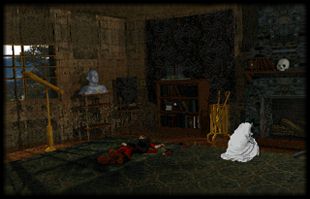
Beautifully rendered graphics which surpass any seen so far in a CD-ROM adventure
game A deep and engaging plot Video-captured actors and cinematic scenes A haunting soundtrack by composer Eric Speier A large world to explore, filled with detail An easy, simple user interface |
Derrat Sorcerum takes interactive storytelling to a new level, with as much attention to a detailed plot as to a spectacular presentation.
"With DS, we wanted to move away from the cuddly munchkin-land games we've all played," says Ben Spees, producer, programmer and graphic artist for the game. "Nowadays, there are two kinds of adventure games in this genre: cute, save-the-princess quests, and hard, apocalyptic desert barbarian games. We were trying to avoid falling into those ruts. "
During the production of DS, close attention was paid to the "realism" of the story. As a result, the game isn't a rehash of older themes. Instead, DS brings an ancient world up-to-date with a storyline more fit for today's game players.
"We tried very hard not to cater to the technology, to tell a story instead of using graphics to wrap up a worthless package." Josh Rothman, Design Team Co-Head for Derrat Sorcerum: "A lot of multimedia titles use fancy graphics and nice movies to make a game look more exciting. I think people are starting to realize that a lot of the CD-ROM games out there are nothing more than polished productions with B-movie plots.
"One of my major concerns was value I've played games where you spend two hours playing and two hours waiting for scenes to load. We wanted a worthwhile game, something that would be worth the fifty or sixty dollars someone would pay for it."
DS is expected to provide between thirty and forty hours of game play for experienced players. "And that's not spent wandering around, yawning and looking at pictures. That's spent playing the game. There's story behind all that time," says Josh.
As much attention was put into the look and feel of the game as was put into the plot. All scenes were immaculately rendered, and occasionally touched up in image-editing programs like Adobe Photoshop. All actors with video-captured in front of blue- and green-screens, and then put into the game. "The video-capture was especially challenging," says Ben, "but it was really worth it. The game has a very film-like feeling to it."
DS's interface was also thought through carefully. "There's recently been a slew of games which use the 'interfaceless-interface' approach, where all you can do is click on things. We felt that this was kind of limiting, and made the game just too simple." DS uses a simple-yet-powerful toolbar at the bottom of the screen to control on-screen action.
Another decision the production team decided to go with was the use of third-person perspective. "We felt that first-person was just not conducive to a cinematic feel," said Scott Richmond, a member of the design team and supervisor for video-captures. "If you try putting a film in first-person, the impact is just not there. First-person has always been used for technical reasons, just because it was easier. But that's just not true anymore. Practically all CD-ROM adventures are played from the first person, from Myst to The 11th Hour. Third person allows for a cinematic fluidity to the action that first person doesn't." All of DS is played from the third-person, with the exception of a few cinematic scenes.
The musical score is a large part of the game. "When Ben sent me the first renderings for the game, I knew that the music would be important," says composer Eric Speier. "It looked like a feature film, and it sounds like one as well." Music for the game was created using a mix of digital and authentic instruments, and the result is impressive.
Derrat Sorcerum was developed in Macromedia Director, which allows for easy porting. "Originally we were worried about Director's speed," says Ben. "But the new version is considerably faster than previous versions." Director will allow minimal tech support and an easy move to the Windows platform if the Macintosh release is successful.
"We wanted the game to draw the player in the same way a good book does," says Josh. "And the way to do that is to provide something for the player to be drawn in to, to have enough depth that you can really become involved. I think we've done that here."